
What BEAD Money Asks of Your Records
We were out at Mountain Connect in Denver last month. It is one of our favorite shows, small enough that you can sit down with an operator and actually talk, and one theme kept coming back. Six sessions on the agenda were about records, compliance or reporting, and nearly all were run by consultants and software vendors rather than operators. That is usually a sign a need is real and nobody has met it yet.
What sits underneath all of it is a detail in how BEAD actually pays.
Does BEAD Pay What the Work Actually Cost?
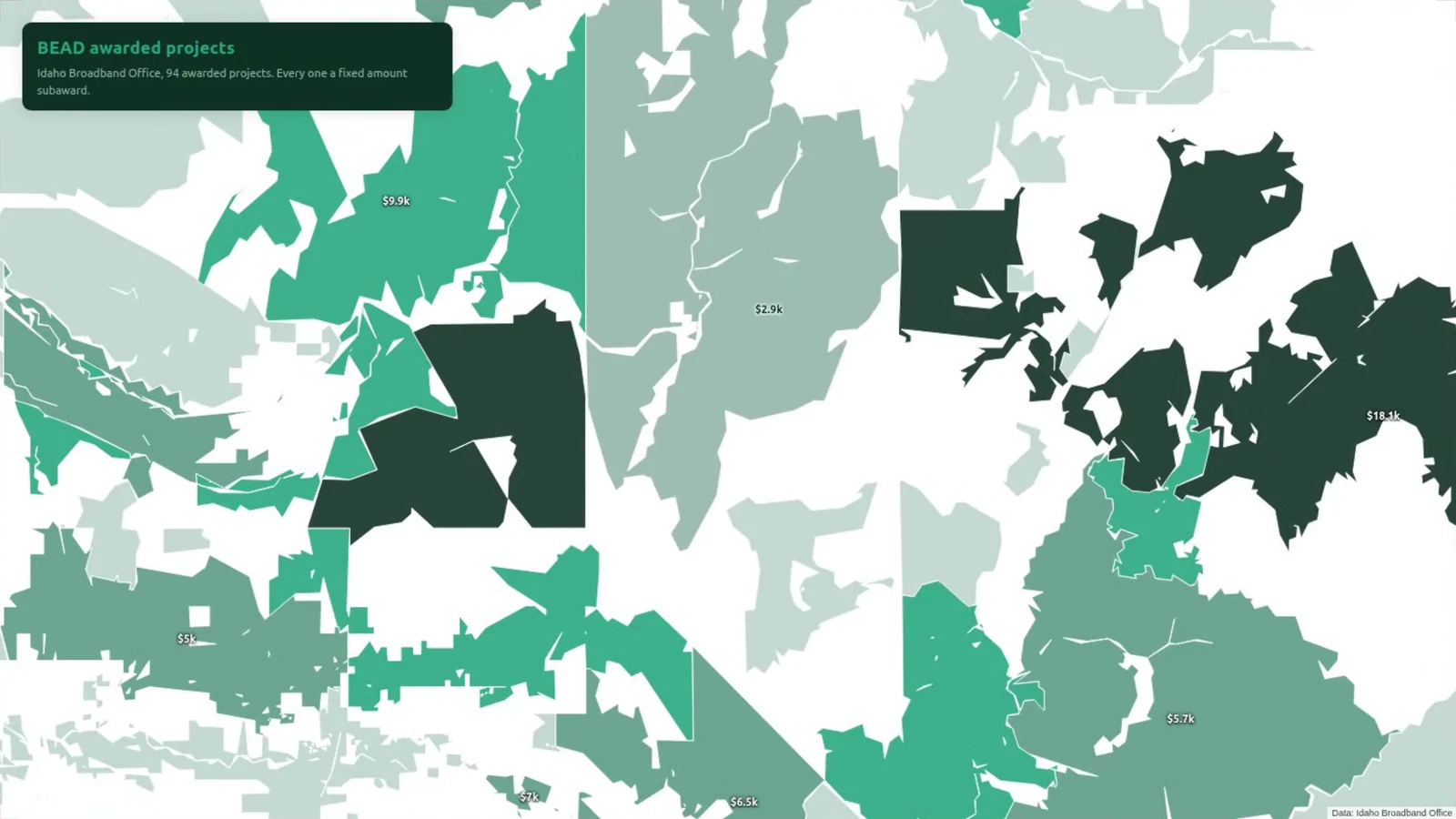
A BEAD subgrant is a fixed amount subaward. NTIA’s guidance is that payments are made “in accordance with either objectives met, units built, or total project complete,” rather than against the costs you actually incurred. The paperwork still calls those payments reimbursements, which makes the distinction easy to miss.
That matters because of what prices have done since these applications were written. A fixed amount award locks in a Cost Per Home Passed at the number you bid, so if 100 feet of cable costs 25% more today than in 2024, the award does not move. You are also asked to disclose high unit costs and overruns against named projects, so the overrun is both yours and on the record. Your records decide whether a milestone gets paid on time or sits in review while interest on your construction debt runs.
What Gets You Paid Is a Location List
The document that releases the money is not a stack of invoices. It is a list of addresses.
Every Broadband Serviceable Location (BSL) and Community Anchor Institution (CAI) in a subgrant is one you have made a federally enforceable commitment to serve, tracked against completion for the life of the program and backed by design, permits, route completion, as-builts and performance testing. Louisiana puts a gate in front of all of it: no ground disturbance, construction or fixed installation on a funded project until every environmental and historic preservation requirement is closed.
So permit status is not paperwork trailing the build, it decides whether the build can start. Some states hand subgrantees a dashboard template showing percent complete for design, permitting and construction. But a dashboard only reports what the systems underneath it already agree on, which is the same gap we went to Fiber Connect to talk about last year: the people who know what got built and the people who report it are rarely in the same system.
The templates differ by state. Louisiana scores every subgrantee for risk and sets the monitoring level from there; Montana files quarterly through its own portal instead. What does not differ is the question underneath every one of them: can you show, per location, what was built, when, and at what cost.
How Long Do Your Records Have to Last?
NTIA set the federal interest period for BEAD funded infrastructure at 10 years after the project is completed, and property records are held until 3 years after the asset is disposed of. Fiber going in the ground this year will still be there in 2060.
That is a long time for a record to survive a vendor relationship. Migrations carry current state, because current state is what a new system needs to operate. Change your FMS in year three, get asked in year seven what the network looked like at the first milestone, and the records may have existed all along in a system nobody kept.
What Does a BEAD Reporting Process Need?
None of this needs a compliance product. It needs a reporting process, and that rests on three things.
Know what you built. A fiber management system that holds your plant as a GIS record, so a route, a splice and an address resolve to the same thing your as-builts claim.
Know what is being built right now. Construction tracking that ties Footage Built, invoices and cost back to the locations they passed, because a home sitting in Homes Passed with no as-built and no spend behind it is one you cannot evidence at milestone review.
Notice when the answer goes wrong. Monthly quality checks, automated reconciliation between systems, and error notifications that reach a person. At BBI we pull these systems into one warehouse and snapshot them daily, so there is a history to move through rather than a current state to reconstruct, and the report gets built once instead of reassembled every quarter. The mismatch you catch this month is the one you do not have to explain in year seven.
Louisiana is furthest along, and the practice being set there is what the other 55 programs will inherit. The operators who come through it well will be the ones who treated their own data as an asset before anybody required it. The rest will reconstruct 3 years of history under a deadline, from systems they have since replaced, and pay a consultant handsomely to help.
If you want a second set of eyes on whether your records would survive a desk review, shoot us a message! We would rather look at it now than in year seven.