AI Agents vs. Chatbots for Broadband Providers
For most broadband providers, the AI they have actually used is a chat window. Somebody on the team pastes in a spreadsheet and asks for a summary, or a vendor ships a feature with an AI badge on it and everyone tries it for a week. That is a reasonable place to start, and it quietly sets one expectation that gets in the way later: that AI is a thing you go and ask.
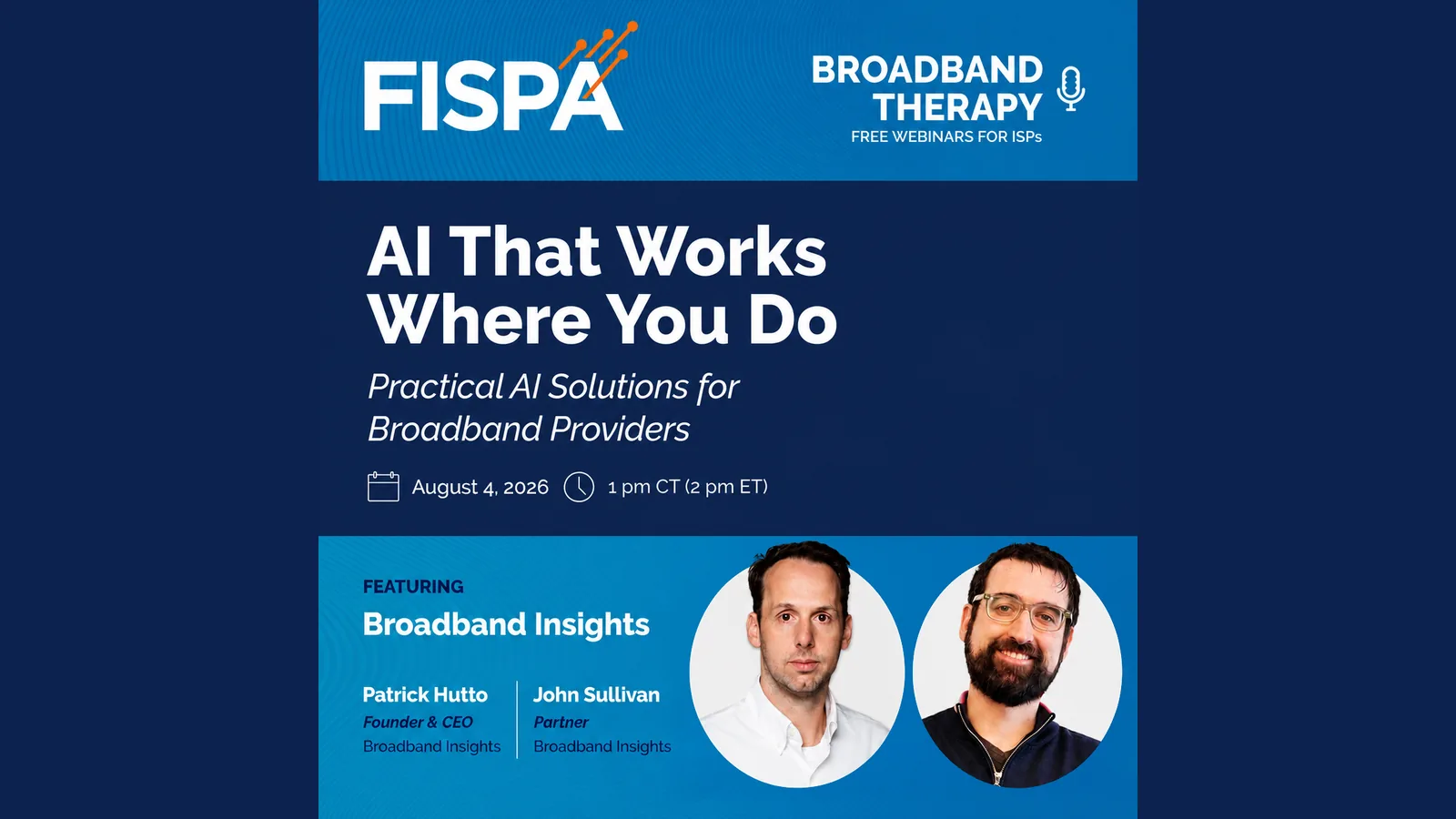
That distinction is where we spent the most time on August 4, presenting “AI That Works Where You Do: Practical AI Solutions for Broadband Providers” as part of Broadband Therapy, the webinar series run by FISPA. We are FISPA members, and Broadband Therapy is one of the more useful things the association does for its membership, putting a working problem in front of operators who will tell you plainly whether it matches their day.
John Sullivan and I were talking to FISPA’s people: independent and rural operators who actually run the network, the truck rolls, the billing, and the support queue. They know their OSS/BSS cold. Most have had no particular reason to work out what the word “agent” is doing in a vendor’s marketing, and that gap is what this post is about.
Ask vs. Act: What Makes an AI Agent Different from a Chatbot
The difference is what starts the work.
- An assistant answers when you ask. It waits for a prompt, and it gives you information. ChatGPT, Claude, and the like.
- An agent works on your behalf. It runs on a trigger, makes a judgment, and acts.
A chatbot answers a question. An agent decides what to do and does it.
The word carrying the weight there is trigger. Nobody opens an agent. It starts because something happened in a system you already run, which means it catches the things nobody thought to go and look at.
That distinction is not just ours. In February 2026 NIST opened an AI Agent Standards Initiative aimed at agents “capable of autonomous actions” that can “function securely on behalf of” their users. When a standards body starts writing rules for something, it has stopped being a marketing word.
An AI Agent Example: Billing, OSS/BSS, and Field Ops
Take an invoice that goes five days past due. That is the trigger, and no person had to notice it.
The agent then checks what someone would have checked if they had the time and the access: open trouble tickets on the account, repeat truck rolls to that address, a recent downgrade, any outages in the area. Those live in three or four different systems, which is exactly why nobody does it by hand for every late invoice.
Then it makes the one call it was built to make. Is this a customer who forgot, or a customer who has been telling you for a month in a different system that they are about to leave? It flags which, before anyone picks up the phone.
Nothing in there is clever. Every one of those checks is something your team already knows how to do. What is different is that it happened without anyone deciding to look.
The Governance Question It Changes
Once an agent can act, the governance question changes shape as well. The version most operators are asking today is “what can our staff paste into ChatGPT.” The agent version is harder and considerably more useful: who inside this company can point an agent at the billing system, what is it allowed to read as opposed to change, and who is accountable when it gets one wrong?
Every operator we talk to arrives at that question on their own, usually third, right after “what would it cost” and “where would we start.” It is not a reason to wait. It is the reason to start small: one workflow, one team, read-only where you can, and nothing in the first pilot that spends money or reaches a customer.
Where This Goes
We have spent years building dashboards for broadband operators, and a dashboard is a good way to find out what happened. The work that interests us now is building the thing that acts on it.
If you want the wider industry picture, NVIDIA surveys around a thousand telecom professionals every year on where AI is actually landing, and publishes it as State of AI in Telecom. It sits behind a form, but it is free and it is worth the two minutes.
Working out where an agent genuinely fits inside the stack you already run is the AI consulting work we do. If you want to talk through whether a particular workflow is a good candidate, reach out to us. And if you run an independent or rural network and you are not in FISPA yet, go and look at what they are doing, because the Broadband Therapy series alone is worth the membership!