Broadband Insights

Your take rate is measured against a number nobody checked

A 40% target on a hundred homes is really a 50% target if twenty of them are barns. The denominator gets set once, early, and almost nobody goes back to look inside it.

Correcting it raises measured penetration without selling one more subscriber, and gives the sales team a target it can be held to fairly.

Send us one service area's worth of records. We will audit a sample at no cost and tell you how much of that count is real.

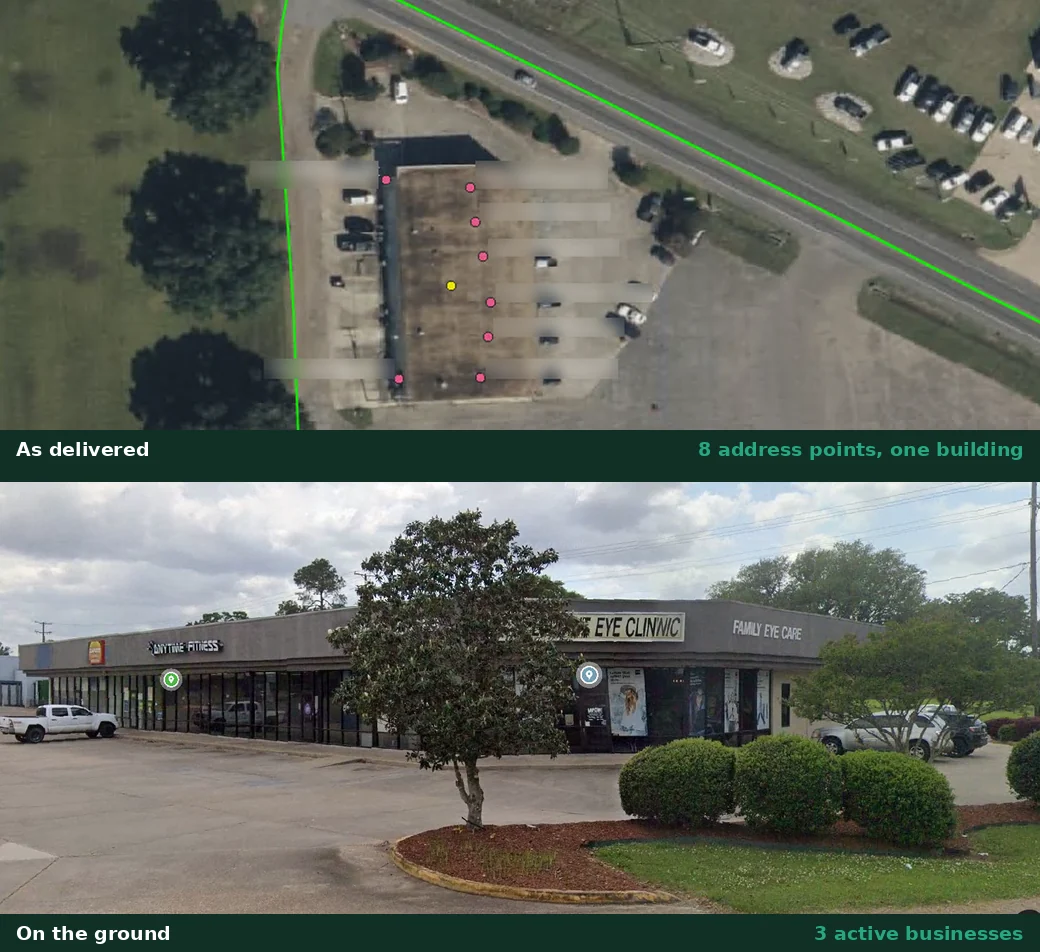
Aerial view of a strip mall carrying eight identical address points, above a street-level photograph of the same building showing three active businesses

The count includes things nobody can buy

Barns, sheds, empty lots and second structures on one parcel all get counted in homes passed. So do duplicates, and a duplicate is rarely one thing. A geocoder stamps two addresses on a single point, the same address gets listed twice, a customer record lands on a passing it already matched.

In one rural market close to a quarter of the addresses collapsed onto a point that was already in the list. Every one of them was sitting in the denominator.

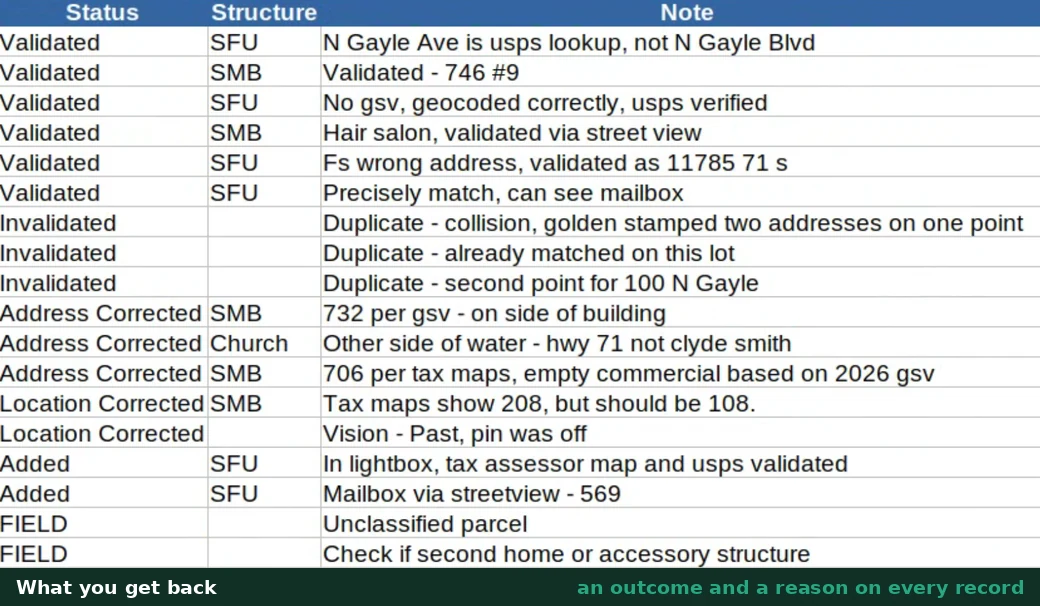
Rows from a returned address file, each carrying its review outcome — validated, location corrected, address corrected, invalidated, added, or flagged for the field — alongside the note explaining why

A number you can put in front of a board

The list comes back as a CSV that joins to your original, carrying an outcome and a reason on every line. Locations that cannot take service are marked and set aside, never quietly deleted.

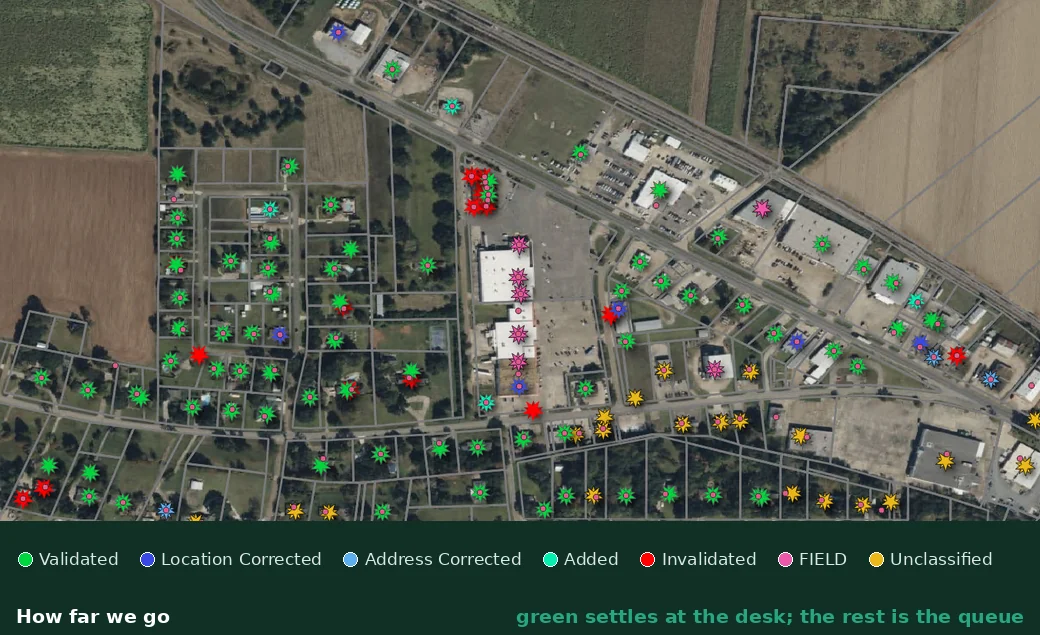
Every record is classified by use and structure. Serviceable passings and marketable addresses stop being the same number as homes passed, and each can be reported on its own.

A service area with every address point colour-coded by review outcome — most validated, with smaller numbers corrected, invalidated, added, or flagged for field verification

Taking homes out lowers the count, and that is the right answer

A phantom passing flatters the build and punishes the people selling it. The same record makes cost per home look better in planning and take rate look worse in reporting.

It usually costs twice. When a geocoder throws a point onto the wrong lot, you are left with a phantom in the count and a real home nobody is contacting — one mistake, counted in both directions.

Most of the list settles at the desk. The remainder — access, tree cover, a structure that might be a second home — is priced separately and only worth resolving where it moves the count.